
News
Lowell Sun: Officials gather at UTEC to advocate for passage of Question 9
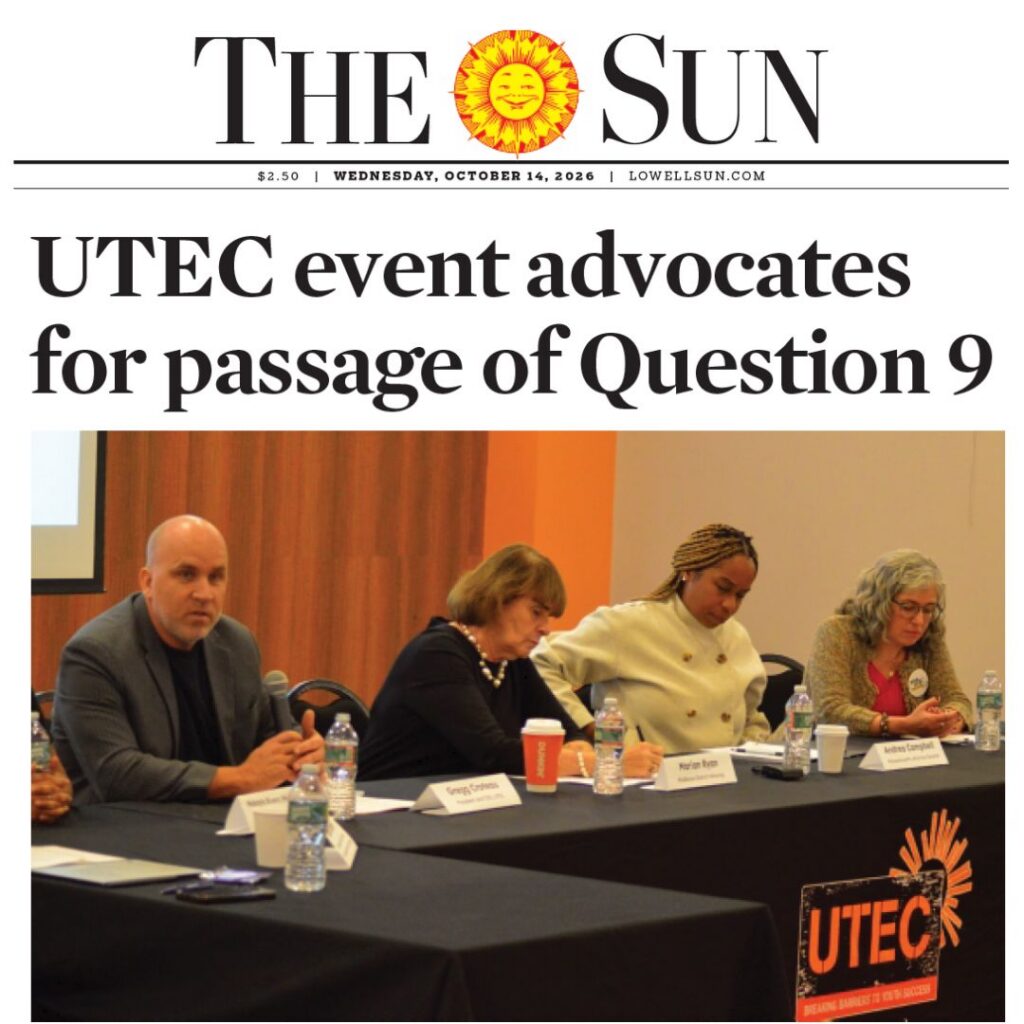
From left, UTEC CEO Gregg Croteau, Middlesex District Attorney Marian Ryan, Massachusetts Attorney General Andrea Campbell and Yes on 9 for a Safe Massachusetts Chair Ruth Zakarin at UTEC in Lowell Oct. 13, 2026 for a discussion in support of ballot Question 9, the passage of which would mean a 2024 state gun law would remain in effect. (Peter Currier/Lowell Sun)
LOWELL — When Massachusetts voters fill out their ballots for the upcoming general election in the midterms, they will be faced with a lot more to decide on than normal thanks in large part to the nine ballot questions that qualified for voter input this year.
The very last question on that list, Question 9, concerns a 2024 firearms bill that was passed by the state Legislature and then signed into law by Gov. Maura Healey through an emergency preamble. The law bans people under 21 from owning semiautomatic rifles or shotguns, requires the serialization of all firearms as a way to tackle “ghost guns” and bans devices that can change a semiautomatic weapon into a fully automatic weapon.
It also includes a “red flag” provision that allows school administrators, healthcare providers and police to seek an order for a specific individual to surrender their firearms and ammunition.
Should Question 9 pass, it would cement the 2024 law in place. Should it fail, Massachusetts gun laws would return to the state they were in before the law was signed.
On Tuesday morning officials advocating for the passage of Question 9 met in Lowell at UTEC, which has endorsed its passage, to talk about why people should vote in favor. Among them were Middlesex District Attorney Marian Ryan, Massachusetts Attorney General Andrea Campbell and Yes on 9 for a Safe Massachusetts Chair Ruth Zakarin.
UTEC CEO Gregg Croteau first recalled the early days of his tenure at UTEC, which he joined in 2000.
“One of the first things I realized when I first started at UTEC was hearing on the street how easy it was to get a gun,” said Croteau. “Now, 26 years later, one of the things I also grappled with was how difficult it is for me to acknowledge that I do not remember every funeral I’ve gone to, many at the hands of guns.”
When the bill was passed and signed in 2024, Zakarin said it represented “the most comprehensive update to our firearms policies in a decade.”
“We understand that technology changes, and the world changes, and we need to change and adapt right along with technology and the world, and we need to do everything possible to weave together a safety net that prevents gun violence and keeps our community safe, and ensures nobody has to grieve,” said Zakarin.
Among the provisions of the gun law is the creation of a firearms data dashboard maintained by the Department of Criminal Justice Information Services and the Executive Office of Public Safety and Security. The dashboard tracks data relating to victim and offender demographics, the legal severity of each offense, and the number of active firearms licenses in the state, among many other data points.
“As we always say, we cannot address a problem we do not understand. One question we need to ask is where those guns are coming from when they land in our communities,” said Zakarin.
Campbell said that since the law was passed in 2024, her office has successfully defended it from 12 different legal challenges.
“The law is working not only in our courtroom, but it is also working in other ways. My prosecutors recently prosecuted a case where investigators recovered a ghost gun that had not yet been fully assembled, along with parts to make it fire faster and parts designed to silence it,” said Campbell. “Under the old law, we would not have been able, or at least would have been very limited, in what charges we could have brought against that individual because the weapon was not yet put together.”
With the new law, Campbell said the person was able to be charged with unlawful possession of a firearm, a machine gun and a silencer.
“Because this law does something the old law did not, it looks at what a device actually does rather than what it is called, and it covers parts, not just fully assembled weapons,” said Campbell.
Before the 2024 law, Ryan said her office could be limited on what kind of charges it could bring against someone in a firearms incident.
“Before this law was passed, when somebody fired into a child’s bedroom, when somebody fired across a backyard where kids were playing, we were able to bring a charge of discharging a firearm within 500 feet of a house. That is a very insignificant misdemeanor. It carries, in general, a fine,” said Ryan. “It does not reflect the people in this city who have told me, ‘I am moving away because I am afraid to let my kids play outside,’ as they should be.”
Ryan went after ghost guns, saying there is no legitimate reason one should have one if they aren’t barred from purchasing a standard gun either because of their age or criminal record.
“The second piece is the danger … because a ghost gun is printed on a 3D printer, when you fire it you risk it blowing apart and injuring the person who is firing,” said Ryan.
Speaking in support of Question 9, Makayla Rivera, a program participant of UTEC, said during the panel that she lost her sister to gun violence in 2023.
“Nobody should have to grieve, nobody should go through that. I definitely want to get involved more in my community and you guys should as well, just to make this place and environment safe for us and safe for the next generation,” said Rivera.
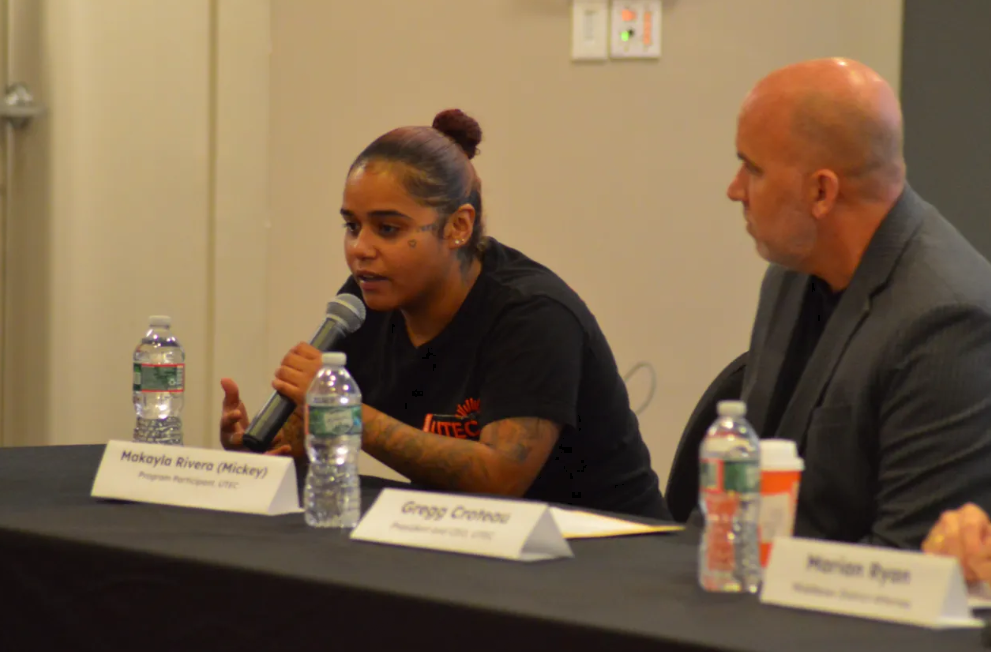
UTEC program participant Makayla Rivera speaks in support of the passage of Question 9 during a discussion with officials advocating for the measure. Question 9 would cement in place a 2024 gun law passed by the state Legislature and signed by Gov. Maura Healey in an emergency preamble. (Peter Currier/Lowell Sun)
The 2024 law has faced pushback from gun rights groups since its passage, with some of the scrutiny pointed toward Healey’s decision to sign it through an emergency preamble, which implemented the law immediately and ensured it could not be paused before a pending ballot question.
The Civil Rights Coalition is among those leading the campaign to get people to vote against Question 9, with the group arguing on its website that the 2024 law carried “sweeping mandates that turn law-abiding citizens into criminals overnight and force honest citizens to reapply for rights they’ve held for decades to comply with confusing, burdensome rules that violate due process and privacy.”
“The law requires registration of all lawfully owned firearms, creating a centralized database of lawful gun owners in Massachusetts. This sets a dangerous precedent for the Government to be collecting this data and raises concerns about the privacy and security of firearm owners’ personal information,” the group says on its website.
After the discussion, Croteau told The Sun that ending gun violence is at the heart of UTEC’s original mission, going back to its beginnings 27 years ago, during a period of increased gun violence in Lowell.
“Anything we can do to use our voice to ensure there are laws … that allow us the foundation to carry out what we are doing around prevention and intervention work, we are going to use our voices as a nonprofit to encourage and advocate for folks to say yes on 9,” said Croteau.
In addition to Question 9, Croteau said UTEC is officially endorsing the passage of Question 4, which would establish same-day voter registration in Massachusetts.
“As everyone knows it is difficult to mobilize people to register to vote, but we know we get people’s attention on Election Day, and I would be a zillionaire the amount of times I’ve met young adults who were disappointed to realize when they thought they could just vote,” said Croteau, arguing that it would help improve voter turnout.