News
Vanna Howard sits down with UTEC young adults ahead of 1st Middlesex state Senate special election primary
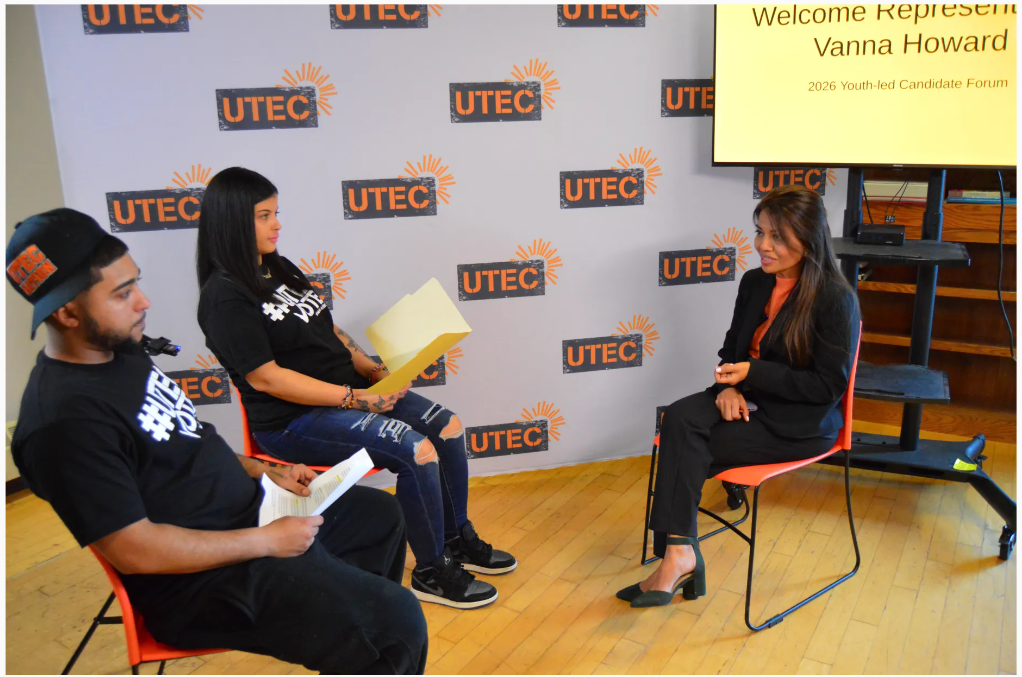
January 23, 2026- Lowell Sun
LOWELL — UTEC’s young adults are once again getting involved in the political process after several of them interviewed both Democratic candidates for the 1st Middlesex District state Senate seat as the Feb. 3 primary approaches.
Candidate Vanna Howard, who currently holds the 17th Middlesex District seat in the state House of Representatives, heard from UTEC staff about the nonprofit’s operations and participated in one of UTEC’s traditional “mood checks,” where staff and young adults rate their moods on a scale of 10 and talk about something exciting in their lives or something they are looking forward to.
Howard then moved upstairs to field questions from Yandel Miranda, 19, and Isabella Mejia, 23, two of UTEC’s young adults who gave similar questions to those posed to Howard’s primary opponent the day before.
They started off again with a question about Howard’s motivation for running for the state Senate seat, to which she responded by saying her career “has always been about helping people.”
“My lived experience in coming here, as an immigrant, as a refugee who didn’t speak a word of English, it wasn’t easy, but this community supported me and helped me and my family,” said Howard, who arrived in the U.S. from Cambodia as a child to escape the Khmer Rouge and Cambodian genocide.
The young adults asked Howard about her view of the current housing situation. Howard pointed to her past support for the legislation to address the housing crisis, including the Affordable Homes Act in 2024.
“That delegated a little bit more than $5 billion into housing, creating housing for young adults dealing with homelessness, and also supporting young adults aging out of foster homes,” said Howard.
“I am proud to support making sure our young adults have safe and suitable housing to live in,” said Howard later, noting her own past experience with homelessness as a young mother in her early 20s.
This special election was called after the death of state Sen. Edward Kennedy last year. Mejia and Miranda pointed to Kennedy’s past support for UTEC’s mattress recycling program, and asked Howard if she would continue to support the program.
“Absolutely. I worked closely with Sen. Kennedy on the mattress recycling program, we actually had discussed the possibility of statewide legislation for the mattress recycling program, and I am also a customer of that program,” Howard said. “What a legacy, to me, for our future generations, for our youth to focus on recycling and conservation.”
Howard also took the opportunity to note her own support for Kennedy when he first sought the state Senate seat.
“When he went for the state Senate seat in 2018, I was there, door knocking for him, believed in him, supported him and endorsed him. We worked great together,” said Howard.
When asked about what she thinks about how the state can support UTEC within the budget, Howard first noted her own support for state funding for UTEC’s many programs, and her hopes to continue to do so.
“It should be continued, this collaboration, and I of course will make sure UTEC continues to receive appropriate funding to continue the many programs helping people,” said Howard.
UTEC has been a champion for “raise the age” legislation, which would raise the maximum age to 20 for those convicted of crimes to be sentenced to a juvenile facility rather than a normal county jail. The main reason is to give those young adults access to the educational programs offered in juvenile facilities, which UTEC argues reduces criminal recidivism.
Howard said she is in support of that kind of legislation, and said she works closely in the Legislature with the bill’s lead sponsors.
“As we all know, your mental and brain develops later in life. I am not for extended terms in general, except for the most serious crimes,” said Howard. “We need to look at suggesting the development of a pilot program to see how it would play out.
Young adults with criminal histories can often have difficulty finding employment after they are released from incarceration. Mejia and Miranda asked Howard about that difficulty, and how she would support the creation of more job opportunities for those people.
“Our young adults should have a second chance, and what UTEC is providing is a proven success,” said Howard. “Training and job skills to make sure they have a path to a job in the future. Regardless of their background, everyone should have a second chance to work on improving their lives.”
Howard said she would continue to support the kinds of services UTEC offers.
The two young adults then asked Howard about support for mental health services, to which she said she has a lot of experience, both from sharing an office with the House’s Mental Health and Substance Abuse Committee, and her previous job.
“My previous job was at Lowell Community Health Center right here, so I have a great deal of knowledge when it comes to issues of mental health,” said Howard.
“We want to do everything we can to make sure we continue to advocate to make sure mental health is moving in the right path, and providing all the resources available to them,” Howard said later.
Similarly, Mejia and Miranda asked about access to other state services like the Registry of Motor Vehicles, and any ways Howard thinks that could be improved.
“I work closely with the RMV to ensure the community can get proper licenses or their ID, because without their ID they cannot get health care, they cannot get jobs,” said Howard. “[House Speaker Ronald Mariano] appointed me to serve on the Commission on Structural Racism in the Department of Correction.”
One issue she found through that committee, Howard said, was that people being released from incarceration were often without any valid forms of identification.
“We were able to implement that with the DOC, staff and admin to make sure before they are being released, to make sure they have all their proper identification,” said Howard.
Howard was asked by Mejia and Miranda about her views on “clean slate” legislation, which would automatically begin the process of sealing criminal records for those convicted of crimes as soon as they are considered eligible.
“I would want to read the language first, but as I mentioned earlier, young adults should be able to get a second chance,” Howard said, adding that a second chance should include things like job training to put them “on the right path.”
She stopped short of supporting such legislation outright, though, and said more serious crimes should be treated differently when it comes to automatically offering second chances.
After the interview, Miranda, a Lawrence resident, said he got involved with Howard’s visit because he wanted to learn more about the political process and the people who make decisions.
“I wanted to get to know the person who may be able to help out and make this community better, and be able to interview that person and meet somebody who makes the decisions on what we are going to do in the city,” said Miranda.
Mejia, a Lowell resident, said she heard about the opportunity somewhat by chance, and jumped on it.
“I wanted to get involved in the community I live in. I feel like Lowell is a community that has just helped me build a good foundation for success, especially with UTEC,” said Mejia. “I am just trying to get involved with the government, learn more about politics, and have a part in deciding who is going to help us and figuring out who supports what we do here, and helping the youth.”