News and Uncategorized
UTEC leads Streetworker Conference on violence prevention

September 26, 2026
FOXBOROUGH — More than 400 streetworkers, community violence intervention practitioners and public health leaders from 120 organizations gathered at Gillette Stadium this week for UTEC’s 2026 New England Streetworker Conference, which was focused on community violence intervention and frontline violence prevention.
This year’s conference centered on a theme that streetworkers, also known as community violence prevention specialists, know firsthand: “Community is the strategy.” Streetworkers are specialized social or outreach workers who engage directly with vulnerable individuals — such as at-risk youth, gang members or people experiencing homelessness.
Streetworkers are often among the first people called when violence happens, and among those working long before a crisis to prevent it. They build relationships with people at the highest risk of violence, mediate conflicts, respond in hospitals and neighborhoods, support people returning from incarceration, connect young people and families with resources, and help communities heal after violence. They are proactive in preventing harm in communities across the region.
The New England Streetworker Conference brings those professionals together not only to learn, but to build the relationships and shared infrastructure that allow community violence intervention work to become stronger across city and state lines.
“For decades, community-based organizations and violence intervention professionals have been doing this work on the front lines, building relationships, interrupting cycles of violence, and creating pathways and opportunity,” said Nichelle Sadler, executive director of UTEC’s Training Center for Excellence. “Today is about recognizing a step toward ensuring that the people closest to the challenges are also recognized as essential partners in creating safer communities.”
The gathering has grown significantly alongside the field itself. UTEC, an agency that started out in Lowell as the United Teen Equality Center but now serves youths up to age 25 across the Merrimack Valley and statewide, launched the conference at a time when street outreach was far less recognized as a formal part of violence prevention.
Today, community violence intervention programs operate across the country, combining trusted relationships and lived experience with structured approaches to outreach, healing and violence interruption.
In Boston, there were 53 shooting incidents through July 19 this year, compared with a five-year average of 68, according to a July 30 report in The Boston Globe. While no single strategy explains that decline, the progress reinforces the value of sustained, community-based prevention work.
The conference gives practitioners a chance to share what is working, learn from one another and strengthen a network that extends well beyond the event.
Frontline expertise
Rather than treating streetworkers only as fringe participants, the conference focuses on their expertise, giving their role center stage.
This year’s sessions addressed conflict mediation and de-escalation, restorative justice, reentry, data and case planning, community healing, engaging men in violence prevention, staff wellness and burnout, and the role of trusted relationships in preventing violence. The conference also created dedicated space for practitioners to exchange strategies, build partnerships and support one another in work that can carry significant emotional and personal demands.
Timmeka Perkins, senior associate at the Annie E. Casey Foundation, based in Baltimore, Maryland, delivered the conference keynote. Perkins’ work focuses on community-based strategies for safety and violence reduction and strengthening the people and organizations leading community violence intervention.
“I have such a deep respect for the work that everybody in here does, the work of the front line. I see y’all. I admire y’all. I look at y’all as heroes, but I also see the human in you,” Perkins said. “Young people are looking for their credible messengers to help them navigate the next part of their life.”
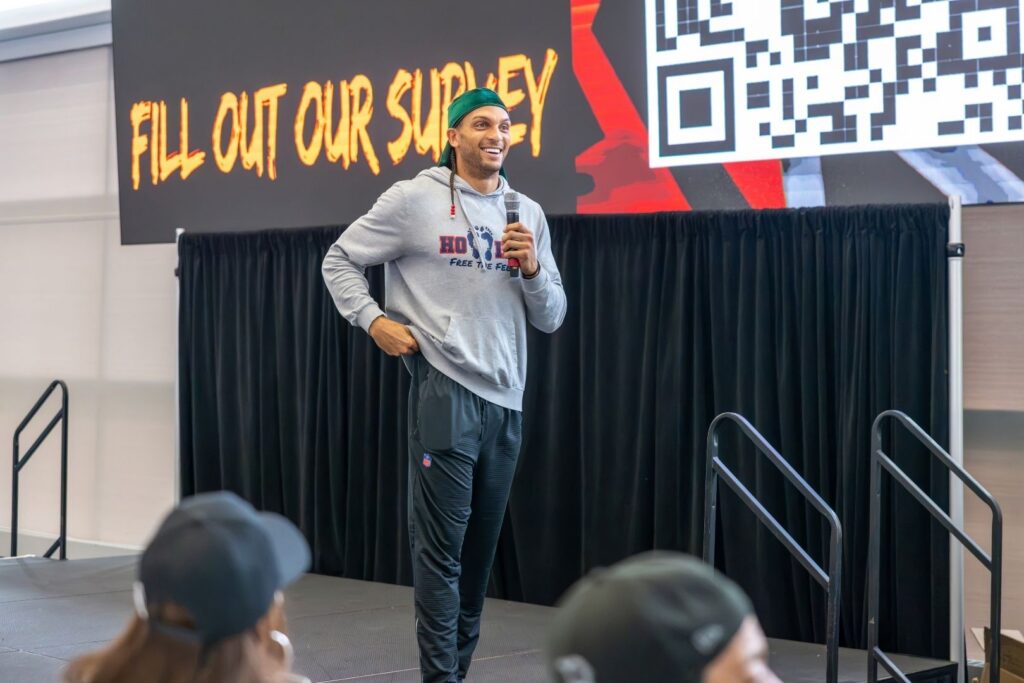
The program also featured Jabee, a three-time Emmy Award-winning musician, educator and community activist from Oklahoma City who serves as executive director of LiveFree Oklahoma and has built community initiatives spanning violence prevention, youth opportunity, arts and economic development. Like many streetworkers, Jabee shared how his activism is rooted in his own experience.
“My purpose has been to help people find their vision, help people find their hope, and community is a strategy,” Jabee said. “Everything I do, I do in my community. Because I know, had somebody not intervened with me that night, I would have been gone.”
“We don’t do a good job at collecting what doesn’t happen — when it isn’t a homicide, when it isn’t an assault, when an ambulance doesn’t come, and when a family or friend doesn’t grieve. You’re doing that work every day,” said Glenn Daly, the director of the state Office of Children, Youth and Families. “It’s been a privilege to be able to walk beside you in this work.”
A network that matters
For frontline practitioners, the value of the conference extends beyond a single day of workshops.
Community violence intervention is deeply local work, but many of the challenges facing streetworkers are shared: gaining trust, mediating conflicts before they become dangerous, supporting families following violence, navigating reentry, responding to trauma and sustaining themselves while repeatedly showing up for others.
Bringing practitioners together gives them a chance to share what is working in different communities and to create relationships they can call on after returning home.
The conference opened with a Networking Night at Patriot Place before the main conference program the next day at Gillette Stadium. The program included remarks and activities led by practitioners from across the field, two rounds of breakout workshops, the keynote address, the Legacy Award presentation and a conference-wide gathering on the field.
Attendees were also joined by Mack Hollins, wide receiver for the New England Patriots. “One of the things I’ve learned over my 10 years in the NFL is you don’t have to have a ‘C’ on your jersey to be a leader,” he said. “You don’t have to be up here on stage to be a leader in your community like you all are.”
Sponsors included the Annie E. Casey Foundation, Fund for a Safer Future, the Massachusetts Executive Office of Health and Human Services, the Massachusetts Gun Violence Prevention Program, GIFFORDS, Health Resources in Action, The New England Patriots, Mass General Brigham Health Plan, and Roca, along with other organizations and partners.
For UTEC, the continued growth of the New England Streetworker Conference reflects something larger: growing recognition that lasting public safety requires people who know their communities, have earned trust, can reach individuals whom traditional systems often cannot, and have the resources, training and professional support to do that work well.
“I’ve been a streetworker for 12 years, and I always learn something new,” said Angel “Ace” Vasquez, Lawrence streetworker manager with UTEC. “When we come together as streetworkers, it’s not only in trainings. It’s talking with each other, having each other’s backs and making sure we’re doing check-ins with each other. That’s community for us.”
UTEC, Inc. helps boost the potential of young people ages 18–25 who are disengaged from school and work or are involved in the justice system. Through street outreach, education, social enterprises and advocacy, UTEC helps young people build skills, heal from trauma and lead change in their communities.